


 Adding research instruments and facilities to the institutional research graph
On Jan 14th, 2026 the Vietsch Foundation announced on their website the awarding of the INST-DSpace project to a group of partners led by euroCRIS. This INST-DSpace partner consortium includes 4Science in Italy and the Technical University of Hamburg (TUHH) in Germany. The main project’s objective is to standardise the inclusion of research instruments and facilities in the open-source DSpace-CRIS software solution for Research Information Management Systems (RIMS/CRIS).
This will be done by expanding the data model underpinning DSpace-CRIS so that the version under development (version 10) includes this additional research entity for equipment. It should be possible for this new entity to be subsequently linked to the already existing ones such as authors, affiliations, projects or research outputs (both research publications and datasets).
This INST-DSpace project webpage summarises the project activity via a series of short posts describing the progress as it happens. These time-stamped posts, with the most recent one at the top, aim to keep the research information management community updated on the project progress. Possible collaborations with other projects working in the same domain will also be highlighted. Finally, this logbook will be used as a source for the reporting to the funder.
The recently announced merger between DSpace and DSpace-CRIS means that this functionality to record instruments and facilities and link them to other entities within the institutional research graph will eventually become available to any institution currently operating a DSpace-based institutional repository.
PROJECT PROGRESS
21 May 2026. INST-DSpace project presentation at the euroCRIS CRIS2026 Conference in Ponta Delgada, Azores, Portugal.
The talk is placed in session 5.1 "Instruments in the Research Graph" together with presentations from Croatia (“Research Equipment in CroRIS in Support of Open Research Infrastructures in Croatia”) and Germany/Ukraine (“Building a FAIR Metadata Mapping Model for Scientific Instruments in the Ukrainian Research Information System: Recovery of Research Infrastructures”).
Previously, an outstanding Day II keynote (“Mapping Research Infrastructure: Opportunities and Challenges from a European Perspective”) has set the scene for the panel discussion to take place at the end of session 5.1, in which the keynote speaker – Ricardo Miguéis, from the INESC Hub in Brussels – joins the session speakers for a discussion with the audience.
The topic of research infrastructures and their inclusion in institutional and/or national CRIS runs across the event programme, with further presentations addressing the experiences in Poland and at the Friedrich-Alexander-Universität Erlangen-Nürnberg (FAU).
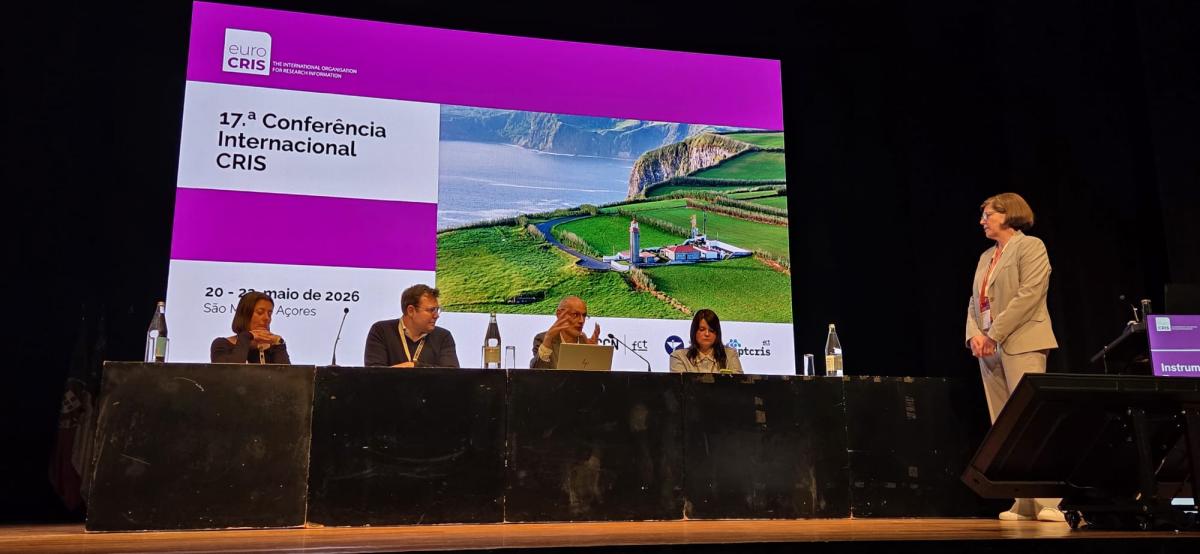
Round table on RIs and their inclusion in CRIS systems at the CRIS2026 Conference. Letf to right: Marina Mayer, Ruđer Bošković
Institute Zagreb, Ricardo Miguéis, INESC Hub Brussels, Pablo de Castro, euroCRIS and Sabina Auhunas, TIB Hannover.
Session chair Pascale Dengis, FRIS Manager, WEWIS Department, Flemish Government.
12 May 2026. Making the case for pooling research infrastructure within European University Alliances
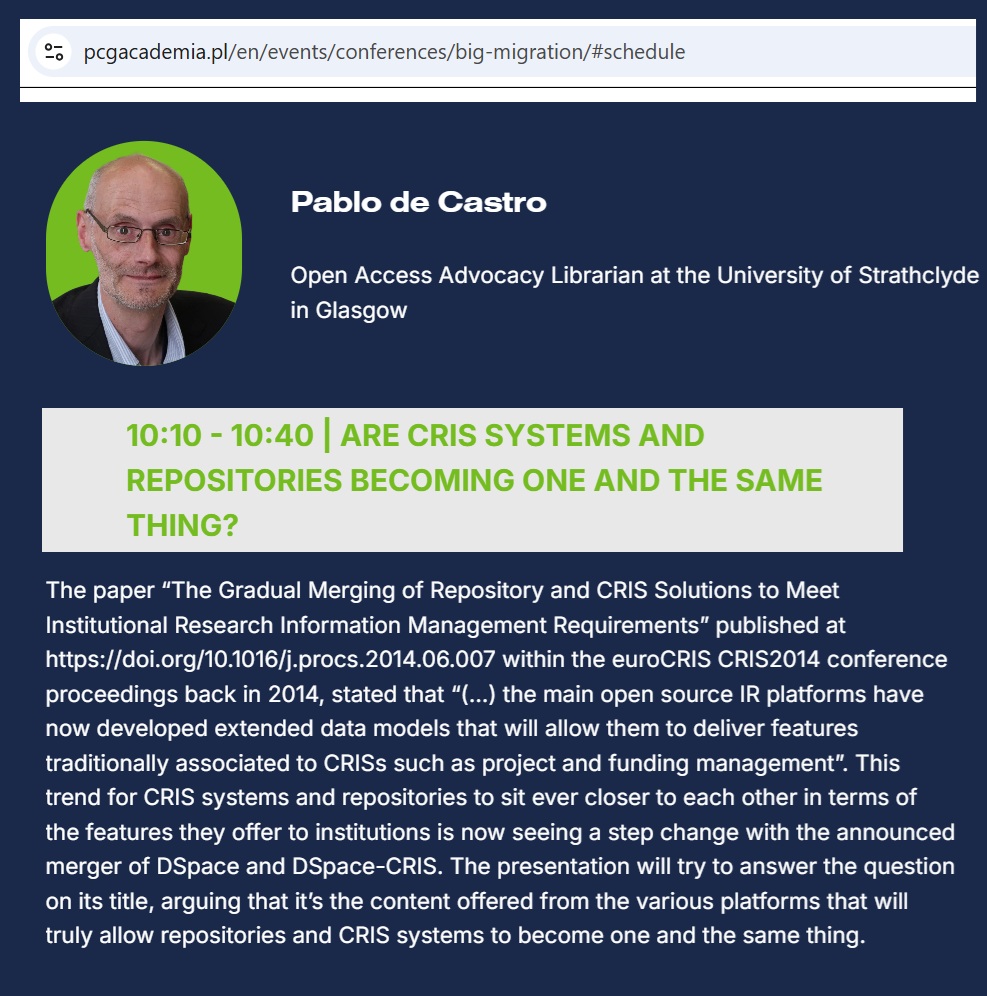
INST-DSpace project explained within the presentation "Are CRIS Systems and Repositories Becoming One and the Same Thing?" delivered at the May 12-13 "Big Migration Conference: On the road to the next generation of scientific repositories" in Warsaw. The case is made for the gradual expansion of the data model allowing European University Alliances — the University of Warsaw is a member of the 4EU+ Alliance — to pool their research infrastructure. There are inspiring examples already for this cross-institutional pooling of equipment and facilities — see for instance the University of Gdańsk-hosted SEA-EU Alliance "shared infrastructure" database. The expansion of the DSpace-CRIS data model will potentially make this sharing far easier.
7 May 2026. Upgraded DSpace-CRIS repository released
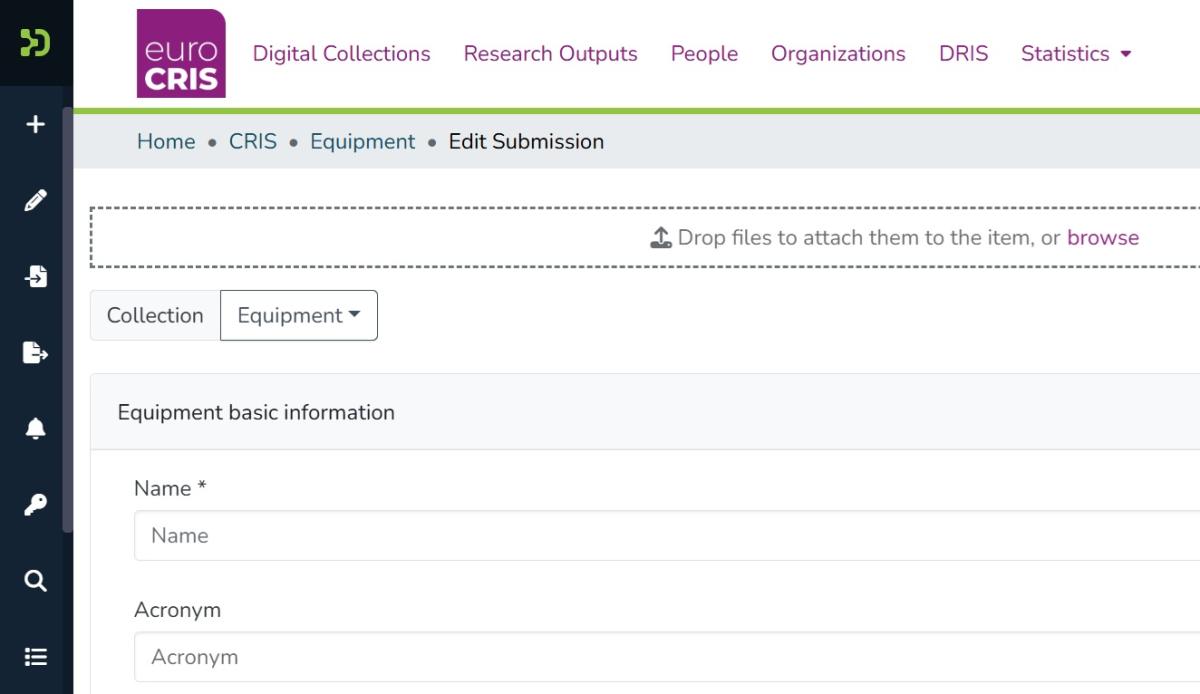
The upgraded euroCRIS DSpace-CRIS (v9) is released by 4Science at https://dspacecris.eurocris.org/. This upgraded version already offers the possibility to add new equipment and facilities into the system. This opens a new phase in the INST-DSpace project, as it will allow euroCRIS to test the cross-linking of research equipment to other research entities in the system.
6 May 2026. INST-DSpace project described at iMarina UG meeting in Granada
The aim of the INST-DSpace project to expand the data model underpinning DSpace-CRIS to include research instruments and facilities in the institutional research graph is explained at the guest keynote on 'The Evolution of CRIS' delivered by the project lead at the iMarina User Group meeting in Granada (Spain). The idea is very well received by the vendor and they express their intention to add this feature to their own development roadmap.
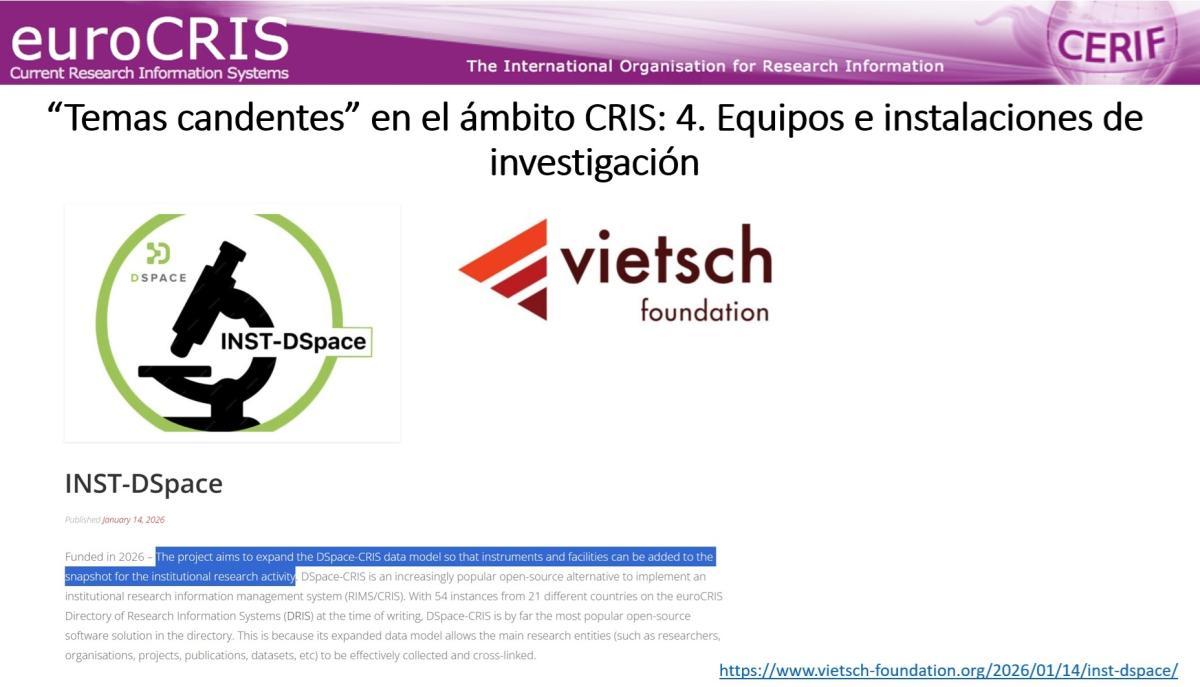
"Hot topics in the CRIS domain: 4. Research equipment and facilities" (presentation was delivered in Spanish)
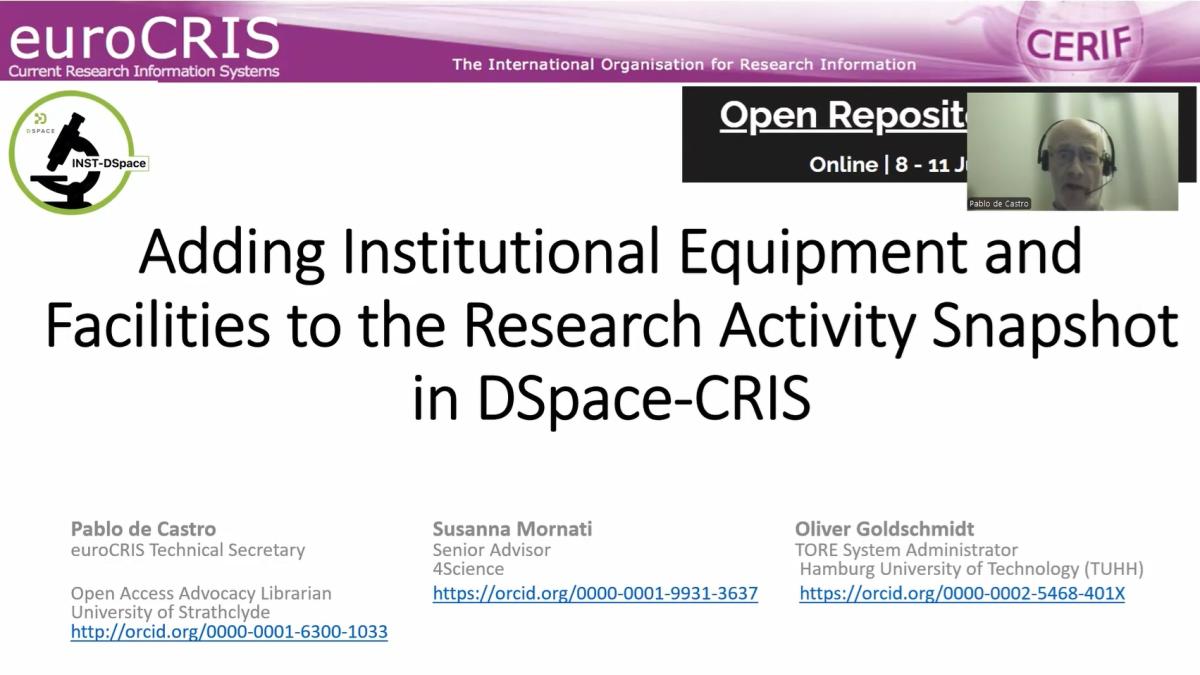
4 May 2026. 3-min INST-DSpace project video sent out to OR2026 for their "Online Express" track
Following the end-of-Feb acceptance of the INST-DSpace project submission to the Open Repositories 2026 conference, the organisers placed it in their "Online Express" track and requested a 3-min video to be delivered so it may be shown online to all event attendees. This video has now been delivered as requested.
30 April 2026. Upgraded DSpace-CRIS validation call between 4Science and euroCRIS
The migration of the euroCRIS DSpace-CRIS has been completed on a development server, but some discussion on its new features is needed between the INST-DSpace project members at euroCRIS and 4Science before the system gets formally released.
10 April 2026. euroCRIS DSpace-CRIS repository set to read-only
The migration of the euroCRIS DSpace-CRIS to v9 starts. This upgrade will allow the equipment and facility research entity to be added to the expanded data model. While all the content is migrated by the INST-DSpace technological partner 4Science, the old version is left running but is set to read only, meaning no nuew content can be added to the system until the upgrade has been completed and the new system gets released.
7 April 2026. "Instruments in the Research Graph" session at CRIS2026 conference announced
On the already released preliminary programme for the CRIS2026 conference, the INST-DSpace project presentation has been placed in a session specifically devoted to "Instruments in the Research Graph". Additional presentations within this session will be delivered by representatives from the TIB Hannover — whose funded project overlaps with INST-DSpace — and from the Ruđer Bošković Institute in Zagreb, where instruments and facilities are currently being incorporated into the Croatian Nanional CRIS CroRIS.
This CRIS2026 Day II session will finalise with a panel discussion with all presenters plus the keynote speaker earlier that day — INESC and RIFF project's Ricardo Miguéis on "Mapping Research Infrastructure: Opportunities and Challenges from a European Perspective".
16 March 2026. INST-DSpace submission to CRIS2026 conference accepted
Comment from one reviewer for the submission reads: "The exploration of use cases — monitoring equipment usage, linking infrastructure to outputs, enabling shared infrastructure databases, and potentially supporting academia-industry collaboration tracking — demonstrates strategic thinking beyond technical implementation. The discussion connects infrastructure visibility with innovation ecosystems and socio-economic impact, which is a strong alignment with current European research policy directions".
12 March 2026. Sixth CERIF surgery devoted to modelling the equipment entity in CERIF
The creation of a specific branch of the GutHub repository devoted to CERIF to host the discussion and the developments around the CERIF entity for instruments and facilities is notified to the euroCRIS members who take part in these CERIF surgeries.
9 March 2026. Second INST-DSpace project meeting
Timeschedule to migrate the euroCRIS DSpace-CRIS platform discussed. This upgraded system is where the testing for the new equipment module will eventually be conducted. Discussion on whether current ORCID profile development might allow instruments and facilities managed by a specific researcher or technician to eventually be added to their ORCID record.
28 February 2026. OR2026 submission on INST-DSpace project work accepted
The proposal “Adding Institutional Equipment and Facilities to the Research Activity Snapshot in DSpace-CRIS” that the INST-DSpace project team submitted to the OR2026 CfP in January has now officially been accepted in the Online Express Lightning Talks track. The Open Repositories 2026 conference, which will be held online this year, will take place from 8 to 11 June.
One reviewer's report for this OR2026 submission states: "The strengths of this contribution are that it has a clear message, a strong practical focus, and a clear target audience. The announced merger of DSpace and DSpace-CRIS further strengthens the relevance of this work, as the presented functionality will soon be applicable to a broad range of institutions currently operating DSpace repositories".
9 February 2026. INST-DSpace kick-off meeting (online)
The INST-DSpace kick-off meeting had all three project partners in attendance (Pablo de Castro, project coordinator, Jan Dvořák, Dragan Ivanović and Treasurer Peter Leijten on behalf of euroCRIS, Susanna Mornati, Andrea Bollini, Riccardo Fazio, Alessandro Laruffa and Nicole Mariani for 4Science and Oliver Goldschmidt and Gunnar Veidt on behalf of the TUHH) to discuss the project’s financial and technical workflows.
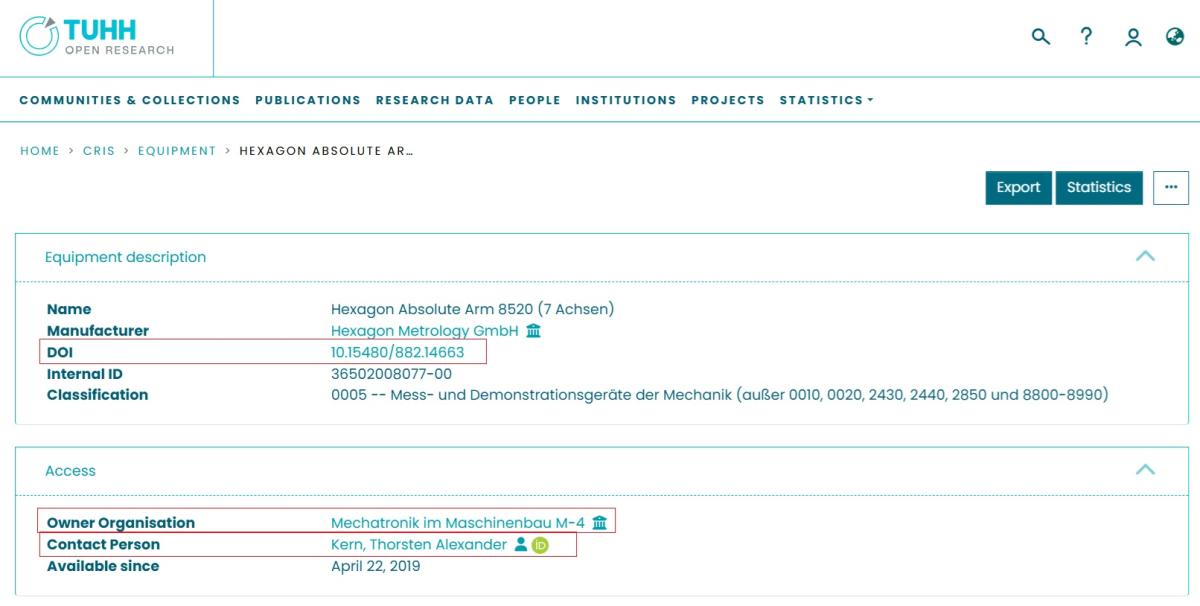
TUHH have already achieved significant progress in the inclusion of their research instruments and facilities in their DSpace-CRIS-based institutional CRIS TORE, as described in Gunnar Veidt’s blogpost. The INST-DSpace objective will be to make it easier for other institutions to replicate this development by having it featured as a specific module in forthcoming versions of DSpace-CRIS. This should allow the linking of instruments to persons, departments/institutes and research outputs like TORE already shows.
As per the project structure, the first steps will address the definition and implementation of the enhanced DSpace-CRIS data model by euroCRIS and 4Science (WP2) and the implementation and testing of the new model for research equipment on the upgraded euroCRIS DSpace-CRIS platform (WP3).
29 January 2026. CERIF surgery on the coding of research equipment and facilities in CERIF
The leads for the CERIF refactoring project Jan Dvořák and Dragan Ivanović, both involved in the INST-DSpace project, have been holding a series of ‘CERIF surgeries’ since Sep 2025 to discuss the needs around the development and implementation of the refactored CERIF with specific euroCRIS members. The fifth one of these surgeries was devoted to the modelling of infrastructure entities within the CERIF Core using their representation in the PIDINST metadata schema as a starting point. This model includes mandatory properties like identifier, schema version, landing page, name, owner, manufacturer, and optional properties such as model description, instrument type, measured variable, and dates.
Together with the structure and persistent identifiers linked to records for instruments, the discussion addressed the need to link research papers and datasets to instruments to track research impact and funding outcomes. This monitoring of the impact of facilities and the translation of research outputs into financial data is often a requirement from funders, see for instance this 2022 report on the socio-economic impact of the Diamond Light Source in the UK.
14 January 2026. Project announcement on LinkedIn
On the same day the INST-DSpace project is announced on LinkedIn (with a link to the Vietsch Foundation project webpage), another LinkedIn post announces the concession by the Alexander von Humboldt Foundation of a similarly scoped project to the TIB Hannover. These two parallel projects – INST-DSpace at euroCRIS and "Scientific Instruments Metadata Mapping" one at the TIB – together with the Masaryk Uni Brno-led RIFF European project, suggest a momentum towards the examination of research instruments and facilities as a suitable addition to the current research graph.